Blog Summary: Women entrepreneurs in Pakistan face financial, mobility, regulatory, digital, and networking barriers. Government support, e-commerce, skills training, and flexible workspaces are creating new opportunities to start and grow sustainable businesses.
Women entrepreneurs in Pakistan face five major challenges: limited finance, mobility restrictions, complex regulations, the digital divide, and limited business networks.
At the same time, new opportunities are growing. E-commerce, fintech, government loans, and flexible workspaces are making it easier to start and grow a business. For example, a flexible Desk can provide an affordable place to work without the cost of a traditional office.
Pakistan has over 115 million women, but only about 24.5% participate in the labor force. Around 1% run an entrepreneurial business. Closing this gap could unlock significant economic growth.
For women building a business, access to the right resources matters. Affordable workspaces can provide a professional environment, networking opportunities, and flexibility. This makes finding the best co-working in Lahore a practical option for women entrepreneurs.
What Are the Main Problems Faced by Female Entrepreneurs in Pakistan?
Before looking at solutions, it is important to understand the main problems women face when starting a business in Pakistan. These problems often connect and make it harder to grow a business.
Financial Challenges for Women Entrepreneurs
Getting money to start or grow a business is a major problem. Many banks ask for property or other assets as security for a loan. Since property is often in men’s names, women may find it hard to get business loans.
Cultural and Mobility Restrictions
Family rules, safety concerns, and social pressure can limit women’s freedom to travel for work. Some women may find it hard to meet suppliers, attend business events, visit banks, or meet investors.
Regulatory and Compliance Confusion
Business rules and paperwork can be hard to understand. Some women keep their businesses informal to avoid this work. But an informal business may have less access to loans, government contracts, and export opportunities.
The Digital and Skills Divide
Some women, especially in rural areas, have less access to smartphones, the internet, and digital tools. This can make it harder to sell products online, use digital banking, or promote a business. Digital skills programs are helping, but the gap still exists.
Weak Networking and Mentorship Access
Women may have fewer chances to meet business owners, investors, suppliers, and mentors. Many business networks are still led mainly by men. Women-focused business groups can help, but access and support are not the same everywhere.
Financial Challenges for Women Entrepreneurs
Access to capital is the single biggest obstacle. Land and property in Pakistan are still overwhelmingly registered in men’s names, so women often cannot offer the collateral banks ask for. Historically, women have made up a small share of total bank borrowers, though this is changing. The State Bank of Pakistan’s Banking on Equality policy has helped open more than 12 million new bank accounts for women, and women now hold roughly 37% of the country’s active bank accounts. Access to formal business loans, however, still lags far behind account ownership.
Cultural and Mobility Restrictions
Family expectations, safety concerns on public transport, and social norms around interacting with unfamiliar men still limit how freely women can attend supplier meetings, trade fairs, or investor pitches. This is one of the quieter but most persistent problems faced by female entrepreneurs, since it affects sales calls, networking, and even the ability to visit a bank branch.
Regulatory and Compliance Confusion
Many women-led businesses stay informal specifically to avoid the paperwork attached to the Companies Act 2017, the Income Tax Ordinance, and provincial labour law. Staying informal, though, blocks access to credit, government tenders, and export documentation later on.
The Digital and Skills Divide
Smartphone ownership and affordable data are still lower among rural women, which limits how much they can use e-commerce platforms, digital banking, or online marketing tools. Digital literacy training has expanded through programs like DigiSkills.pk, but the rural-urban gap has not closed yet.
Weak Networking and Mentorship Access
Business chambers, investor circles, and supplier networks in Pakistan remain male-dominated. Women Chambers of Commerce and Industry exist in most major cities, but their influence on policy and deal flow is still smaller than mainstream chambers.
Gender Inequality in Business: Where Does Pakistan Stand Today?
Gender inequality in business shows up clearly in the data. A World Bank report on women’s economic empowerment in Pakistan found that in non-agricultural sectors, only 23% of employed women are entrepreneurs, compared with 33% of employed men. The same research points to transport, safety, childcare, and asset ownership as the strongest predictors of whether a woman starts and sustains a business.
The good news is that the role of women in Pakistan’s economy is shifting from the policy level down. The State Bank of Pakistan’s Governor has publicly tied national economic resilience to closing the gender gap in entrepreneurship, and SMEDA appointed its first woman CEO in 2025, a signal that institutional leadership is starting to reflect the population it serves.
Women Entrepreneurs Shaping Pakistan
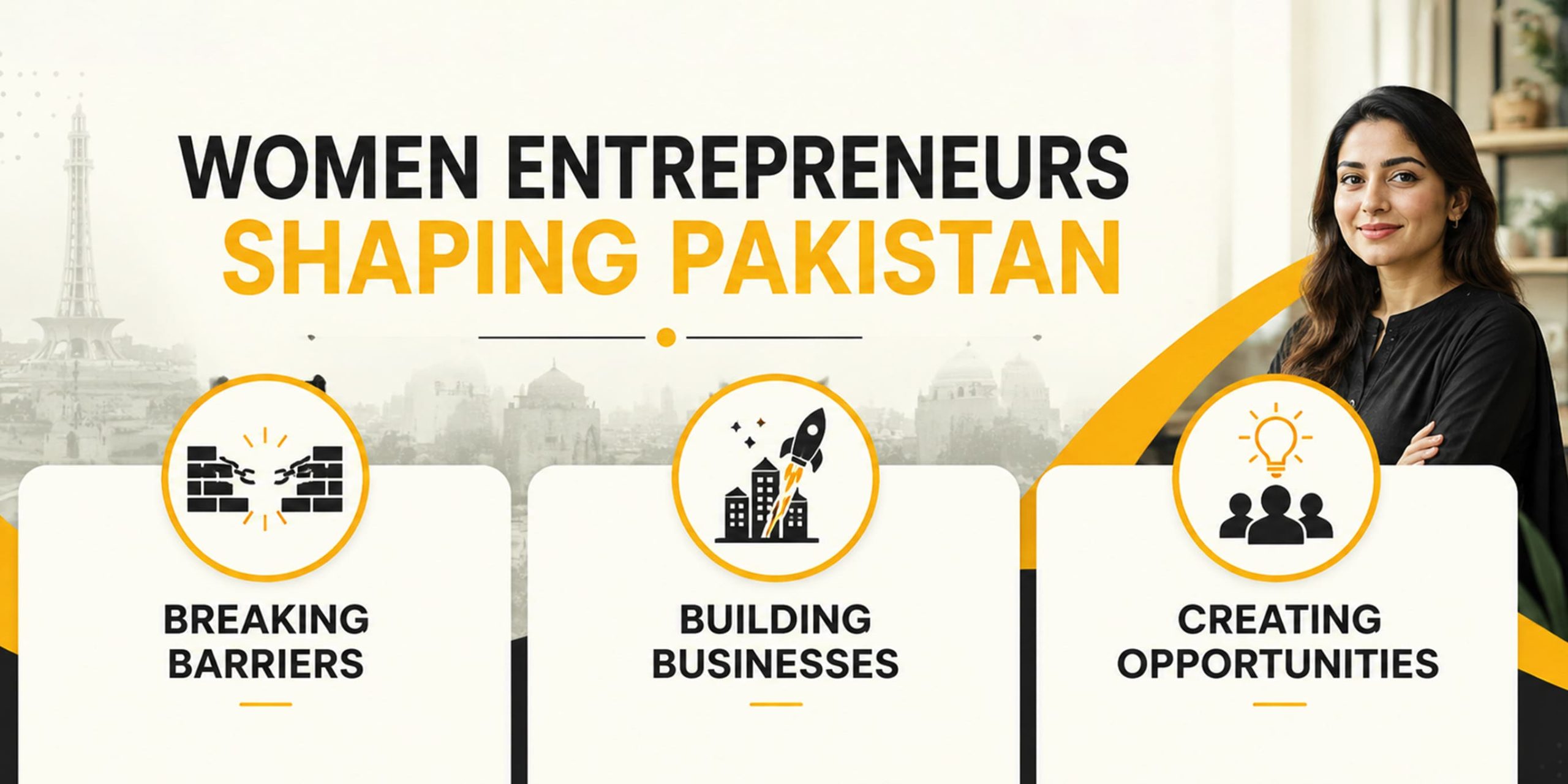
Breaking Barriers
A growing number of women are formalising businesses that used to run informally out of homes. SMEDA’s SME Registration Portal now offers free registration, removing one of the biggest excuses for staying unregistered. Women are also entering sectors once considered off-limits, including logistics, IT services, and light manufacturing.
Building Businesses
From telemedicine platforms to boutique export brands, women founders are building structured companies rather than one-person side hustles. Coworking spaces have played a quiet but real role here, giving founders a professional address, meeting rooms for client calls, and a working environment separate from domestic responsibilities.
Creating Opportunities
Every woman who formalises and scales a business becomes an informal mentor for others nearby. This ripple effect is exactly why donor agencies and government programmes have started ring-fencing funding for women-led SMEs specifically, rather than folding them into general SME support.
Business Opportunities for Women in Pakistan Worth Exploring
Despite the barriers above, this is genuinely one of the best moments in years to start a business as a woman in Pakistan. Here is where the momentum is strongest.
Small Business Ideas for Women in Pakistan
- Home-based baking or catering
- Handmade jewelry making
- Tailoring and custom stitching
- Event decoration services
- Photography services
- Interior styling
- Childcare services
- Floral arrangement business
Online Business Ideas for Women in Pakistan
- Online language teaching
- YouTube content creation
- Podcasting
- Affiliate marketing
- Website development
- App development
- Online bookkeeping
- Virtual event hosting
Work-From-Home Business Ideas for Women
Working from home is a reasonable starting point, but it comes with real trade-offs: constant interruptions, no separation between family life and client calls, and an address that looks unprofessional on an invoice. Many founders outgrow the kitchen table within the first year and move to a shared desk or day pass before committing to a full office lease.
How to Start a Business as a Woman in Pakistan: A Practical Path
- Validate the idea with 10 real customers before spending on inventory or branding.
- Register with SECP or SMEDA’s free portal to unlock credit, tenders, and legal protection.
- Open a business bank account and separate personal and business finances from day one.
- Apply for a relevant SBP-backed loan scheme once you have basic financial records.
- Set up a professional base, even a Private Office or shared desk, to host clients and receive mail.
- Build one sales channel fully (Instagram, Daraz, or WhatsApp Business) before spreading across five.
- Track cash flow monthly so you can show lenders and partners real numbers, not estimates.
Government Schemes and Loans for Women Entrepreneurs in Pakistan
Several structured programs specifically target women-led businesses:
| Scheme | What It Offers |
| SBP Refinance Scheme for Women Entrepreneurs | Concessional loans up to PKR 5 million |
| Kamyab Jawan Programme | Youth and women business loans |
| Kamyab Pakistan Programme | Interest-free loans for low-income women, farmers, and youth |
| Assan Karobar Finance (PSIC) | Interest-free loans for women-led small enterprises in Punjab |
| SMEDA SME Registration Portal | Free formal business registration |
Uptake of these loans for women entrepreneurs in Pakistan is still low relative to demand, mostly due to awareness gaps rather than lack of funding, so it is worth checking directly with SMEDA’s outreach desks or your provincial Women Chamber of Commerce for the current eligibility criteria.
Women Entrepreneur Success Stories From Pakistan
Women across Pakistan are building successful businesses in many fields.
Sehat Kahani is one example. It was started by women doctors. The platform lets patients talk to doctors online. This helps women doctors work from home and reach more patients.
Women in Gilgit-Baltistan and Hunza have also started small businesses. Some sell honey, embroidery, and traditional items. With support from local business centers, some have turned these small businesses into registered companies.
These stories show that women can start and grow businesses with the right skills, support, and access to resources.
Why a Coworking Space Solves More of These Problems Than People Expect
A surprising number of the barriers above shrink once a founder has a professional, shared workspace instead of a kitchen table or a rented commercial unit she cannot yet justify. Our detailed breakdown on Coworking Spaces That Support Women Entrepreneurs covers this in depth, but the short version is this: a shared workspace gives you a business address for registration, meeting rooms for client pitches, a built-in network of other founders, and childcare-friendly hours without the multi-year lease commitment of a private office. Founders who are not ready for a full-time desk can start with a Virtual Desk to get a registered business address and mail handling while working remotely, then scale up as revenue grows.
The Bottom Line
Women entrepreneurs in Pakistan still face many challenges. But things are changing. Loans, online tools, and shared workspaces are making it easier to start a business.
Women can start by registering their business, building one strong sales channel, and finding a good place to work. They do not have to do everything from home.
Frequently Asked Questions
How many businesses in Pakistan are owned by women?
Women own less than 10% of registered SMEs in Pakistan, according to SMEDA. Most of these businesses stay small because they never move past the informal stage.
Do you need to own property to register a business in Pakistan?
No. Registering a business only needs a CNIC, a business name, and an address. Owning land or property matters more when you apply for a bank loan, since most lenders ask for it as collateral.
Do women entrepreneurs need a physical office to register in Pakistan?
No. SECP and SMEDA both accept a registered address, which can be a home address, a virtual desk, or a coworking space. A dedicated office is not required to complete registration.
Which industries are growing fastest for women-led businesses right now?
E-commerce, fintech-enabled retail, and health-tech are growing the fastest. All three let a founder start with low upfront cost and reach customers directly through a phone.