
The coworking trend in Pakistan is changing how businesses think about office space. Instead of taking on long leases and costly setup work, companies can choose flexible workspaces with ready-to-use offices, essential amenities, and room to grow. This is especially useful for startups, freelancers, remote teams, and growing businesses.
As demand rises, finding the best coworking space in Lahore is becoming less about having a desk and more about getting the right mix of flexibility, location, facilities, and value. This guide explores the drivers of coworking growth and what businesses should consider before choosing a workspace.
The Growth of Coworking Spaces in Pakistan
Coworking in Pakistan started small. A few shared desks in Lahore and Islamabad, mostly used by freelancers and small tech teams. That picture has changed completely. Today, coworking spaces are used by startups, remote teams, SMEs, and multinational satellite offices as a core part of how they operate, not just a temporary fix.
The freelance economy is a big reason for this. The country now has one of the largest freelance workforces in the world, with estimates placing the number of active freelancers at between 2.3 and 2.4 million. According to a Pakistan Today Profit report citing Asian Development Bank data, Pakistani freelancers earned $557 million in the first half of FY26 alone, a 58% jump year over year, driven by demand in software development, digital marketing, and content creation. That kind of export growth needs professional infrastructure, and home setups or cafés cannot keep up.
The pattern matches what is happening globally too. The Business Research Company’s Coworking Space Market Report values the global flexible workspace industry at over $30 billion in 2026, growing at roughly 15% a year through 2030. Coworking growth is following the same curve, just a few years behind, which means the fastest expansion is still ahead.
Why Is the Shift Happening?
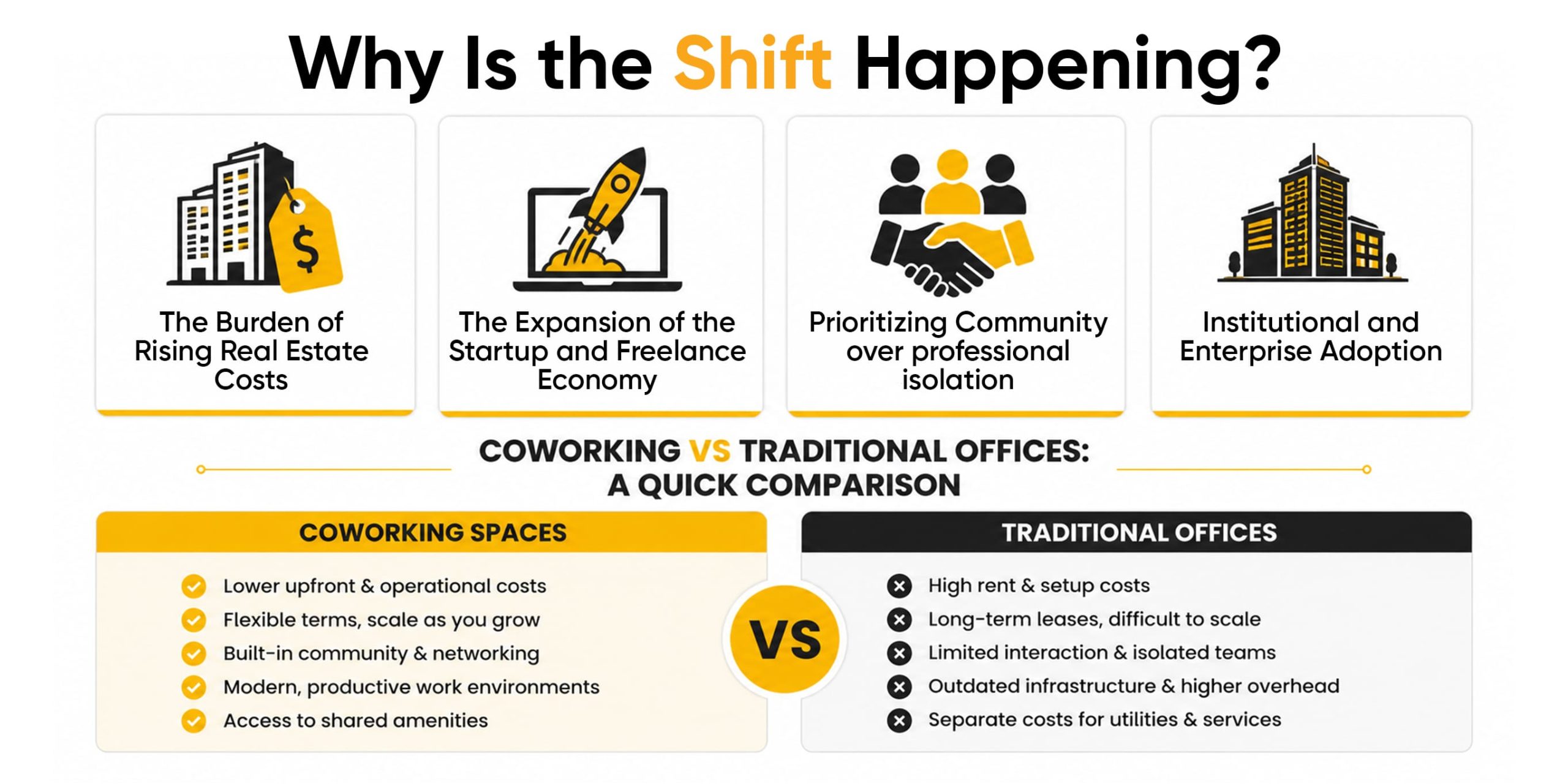
Four forces are pushing Pakistani businesses toward flexible offices at the same time. Together, they explain why coworking vs traditional offices is no longer a close debate for most growing teams.
The Burden of Rising Real Estate Costs
Commercial rents in Lahore, Karachi, and Islamabad keep climbing every year. On top of rent, a traditional office needs furniture, generators or UPS backup, internet setup, security staff, and admin overhead. All of that is capital spent before a single employee starts working. A coworking or managed office space folds these costs into one predictable monthly fee, which is why so many founders now treat flexible workspace Pakistan options as the default, not the backup plan.
The Expansion of the Startup and Freelance Economy
Pakistan’s freelance and startup population needs infrastructure that a 3 to 5 year lease simply cannot offer. A trusted startup office lets you add or remove seats as your team changes, without changing the whole contract. Coworking spaces offer this flexibility
Prioritizing Community Over Professional Isolation
Working from home or in a private office can limit business connections. Coworking spaces bring founders, developers, marketers, and other professionals together in one place. This makes it easier to meet potential clients, partners, and new team members. That is why many hybrid teams are choosing coworking spaces over traditional private offices.
Institutional and Enterprise Adoption
It is not just startups anymore. Larger companies and multinationals are using managed offices to open satellite teams in new cities without the months-long process of building a standalone office. This lets them test a market or hire locally in Lahore or Islamabad fast, then scale the space up if it works.
How Coworking Trends in Pakistan Are Changing City by City
The coworking trend does not look the same in every city, and that matters when you are choosing where to base your team.
Lahore has become the country’s most active coworking market. Its mix of universities, tech startups, and a fast-growing freelance base means demand for shared office space keeps rising, especially in areas like Johar Town that sit close to residential neighborhoods and business hubs alike.
Karachi, as Pakistan’s largest commercial city, has the highest concentration of corporate and multinational demand, with coworking increasingly used for satellite offices and client-facing teams.
Islamabad leans more toward government-adjacent consulting firms, NGOs, and remote teams who want a professional address without the overhead of a full office.
What to Look for Before You Choose a Coworking Space
Not every coworking brand offers the same value. Before signing up, check these points:
- Location and commute: A space close to your team’s homes or client base saves hours every week.
- Real capacity, not just marketing photos: Ask how many seats and private offices are actually available on your preferred floor.
- Backup power reliability: Pakistan’s power situation makes this non-negotiable for any serious business.
- Contract flexibility: Confirm you can scale seats up or down without penalty.
- Community and amenities: Recreational areas, event spaces, and prayer facilities matter more than they sound on paper, especially for retention.
This is exactly where Lahore’s coworking scene has matured the most. WorkPod, the largest coworking space in Johar Town, Lahore, was built around these expectations. Instead of just renting desks, WorkPod offers a private office setup for growing teams, a flexible desk option for freelancers and small teams who need month-to-month terms, and a day pass for professionals who just need a productive space for a few hours. Add in high-speed internet, valet parking, a daycare facility, and community events, and it becomes clear why WorkPod is positioned at the front of Pakistan’s coworking trend rather than just another shared office provider.
Is Coworking Right for Your Business?
Coworking fits best when your team size is not fixed, when you want to enter a new city without heavy investment, or when you simply want your staff working from a professional space instead of home. It fits less well for large enterprises that need permanent, fully customized floors under their own control for the next decade.
For most startups, SMEs, remote teams, and even large companies opening satellite offices, the flexible office model now offers a stronger return than a traditional lease. Rents keep rising, teams keep changing shape, and the businesses adapting fastest are treating coworking as a core strategy, not a stopgap.
Frequently Asked Questions
What is the coworking trend in Pakistan right now?
Businesses are moving away from long-term office leases toward flexible offices that offer month-to-month terms, shared amenities, and quick move-in, driven largely by the growth of the freelance and startup economy.
Why are startups choosing flexible offices over traditional leases?
Flexible offices need little upfront capital, let teams scale seats up or down without renegotiating contracts, and come move-in ready within days instead of the weeks or months a traditional office fit-out takes.
Which cities have the strongest coworking growth?
Lahore leads in overall coworking demand, driven by its startup and freelance base. Karachi sees the most corporate and multinational uptake, while Islamabad’s demand comes mainly from consulting firms, NGOs, and remote teams.
Is coworking cheaper than a traditional office?
Yes, in most cases. Coworking removes upfront costs like furniture, fit-out, and utility setup, replacing them with one predictable monthly fee that already includes internet, power backup, and shared amenities.
How is Pakistan’s freelance economy connected to coworking growth?
It has one of the largest freelance workforces globally, and that income growth is creating steady demand for professional, reliable workspace outside the home, which is fueling coworking growth directly.
Can large companies use coworking spaces too?
Yes. Many multinationals and larger corporations now use managed coworking offices to set up satellite teams in new cities quickly, avoiding the cost and delay of building a standalone office from scratch.